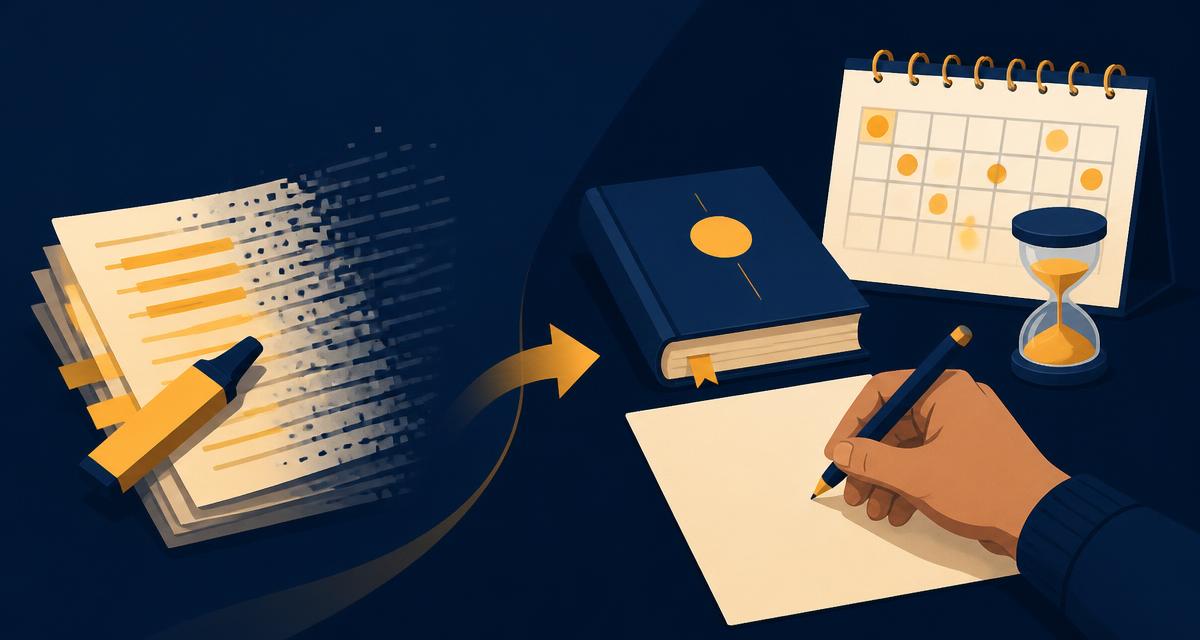
Most children revise by re-reading, which feels productive because they recognise the words. Recognition is not recall. Testing yourself, spreading practice across days and mixing topics all feel harder and work far better.
Key takeaways
- Re-reading creates a feeling of knowing that disappears the moment the page does
- Retrieval practice - closing the book and writing down everything you can - beats re-reading by a wide margin
- Spacing the same total time across more days sticks better than one long cram
- Mixing topics rather than blocking one at a time feels harder, and that difficulty is the point
- The methods that feel productive are usually the weak ones; the methods that feel like hard work are usually the strong ones
The best-kept secret in education
Here is one of the best-kept secrets in education: most children revise in a way that barely works, and it isn't their fault. Nobody taught them how.
The usual method is to read the notes again, maybe highlight a bit, and read them again. It feels productive. You recognise the words, so your brain says "yes, I know this."
Why the good feeling is the trap
That feeling is the trap. Recognising something on the page is not the same as being able to recall it when the page is gone, and the exam is all about the page being gone.
Decades of research point to a better way, and it's uncomfortable, which is exactly why it works.
Retrieval practice: try to remember, not to re-read
Instead of re-reading, your child should try to remember. Close the book and write down everything they can. Test themselves. Get things wrong, then check.
This is called retrieval practice, and study after study shows it beats re-reading by a wide margin, even though re-reading feels far nicer at the time.
Two more that cost nothing
Spread the practice out
Spread the practice out instead of cramming it. The same total time in shorter sessions across more days sticks far better.
Mix the topics up
Mix topics up rather than doing one in a big block. It feels harder, and that difficulty is the point. Struggling a little while you retrieve is what builds the memory.
The uncomfortable truth
The uncomfortable truth underneath all of this is that the methods that feel productive are usually the weak ones, and the methods that feel like hard work are usually the strong ones. A child who learns that early has an advantage that compounds across every subject, for years.
This is one lesson from one module of YoungThinkr, our curriculum that teaches children how to think, and how to learn, from age eight to sixteen. We're opening a free beta to a first group of families now. If you have children in that range, come and test it, and tell us the truth.