Almost every parent wants a child who can think for themselves, yet school mostly measures memory, not judgement. This piece is about why that gap quietly decides a life, and what we built to close it.
Ask almost any parent what they most want for their child, and somewhere near the top you will hear a version of the same thing: "I want them to be able to think for themselves."
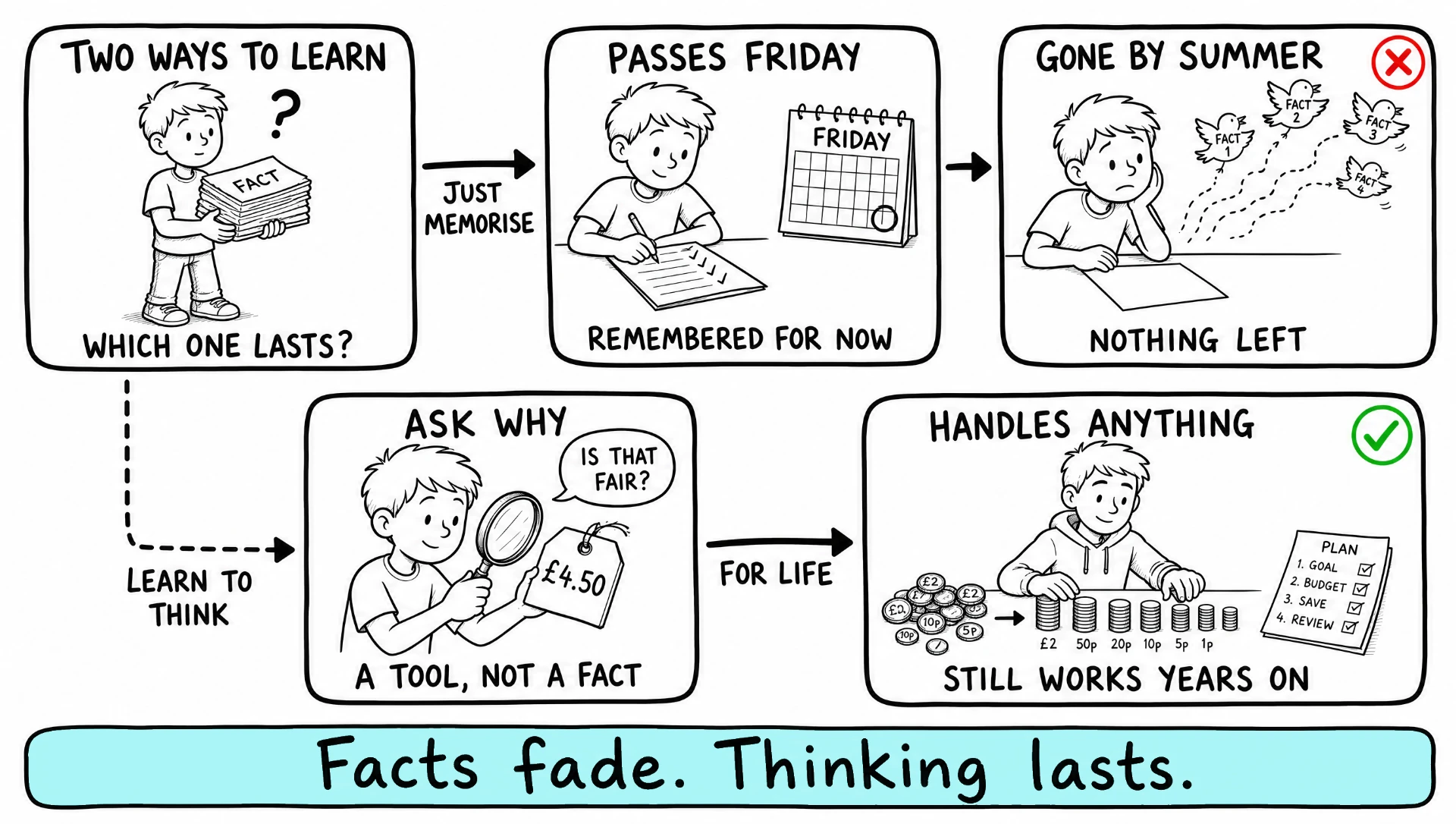
Now look at what school actually measures. Recall. Dates, formulas, spellings, facts, most of them gone by the summer holidays. We test whether a child can remember an answer. We very rarely teach them how to arrive at one.
That gap is the thing this whole project is built to close.
Key takeaways
- School mostly rewards recall, but the skills that shape a life - judgement, questioning, handling money and emotions - are rarely taught directly
- "How to think" is not woolly. It is a concrete, teachable toolkit that the world's sharpest minds spent centuries working out
- These skills matter more than ever now that information is infinite and AI can produce confident, wrong answers on demand
- YoungThinkr teaches them across seventeen connected topics, from age eight to sixteen, adapting to each child, and is designed to sit alongside school
The skills that quietly decide a life
Your child will spend their life making decisions nobody sat an exam on. Whether to believe a confident-sounding video. Whether a deal is as good as it looks. How to handle a wave of anxiety before something hard. How to tell a strong argument from one that only sounds clever. How to earn trust, and how quickly it disappears. How money actually works before the world teaches them the expensive way.
None of that is on the syllabus. And yet it is precisely this layer, the thinking underneath the facts, that separates the people who navigate life well from the people who get swept along by it.
We are not against knowledge. A child needs to read, count, and know things about the world. But knowledge without the ability to question, weigh, connect and apply it is brittle. It passes the test and then falls over the moment the world asks a question the textbook didn't.
What we mean by "how to think"
It is not vague. It is a real, teachable set of tools, and humanity's sharpest minds spent centuries working them out.
First principles reasoning, the habit of stripping a problem back to what is actually true and rebuilding from there, the same move Elon Musk used to rethink the cost of a rocket. Systems thinking, seeing the loops and connections that make traffic jams, trends and family arguments behave the way they do. Spotting the mental shortcuts that fool every human brain. Reading a statistic sceptically. Understanding how an algorithm decides what you see. Knowing how trust is built and broken. And, underneath all of it, knowing how to learn, so that everything else gets easier.
These are not abstract. A child who has them is harder to fool, faster to adapt, calmer under pressure and more confident that the world can be figured out.
Why now
Two things have changed. First, information is infinite and much of it is designed to mislead, so the ability to judge it matters more than the ability to recall it. Second, AI can now produce fluent, confident, wrong answers on demand, which makes independent judgement not a nice-to-have but a form of protection.
The child who thrives in this world is not the one who memorised the most. It is the one who can think.
Where we come in
YoungThinkr is the missing subject. It teaches children how to think, across seventeen connected topics, from age eight to sixteen, adapting to each child. It is careful, honest and evidence-based, and it is built to be done alongside whatever else your child is learning, not instead of it.
So how do you find out how your child thinks?
Our free Thinkr Profile is the easiest way to start. It takes ten minutes, it is completely free, and there is no card, no account and no pressure. Your child works through six real-world problems, and you see how they approach decisions, money, unfamiliar situations and tricky questions.