Every parent has been burned by an "educational" app that was really a slot machine with a mascot. Here is the honest answer to how YoungThinkr is different: it adapts to your child, teaches the truth including where experts were wrong, and gets them off the screen and talking to you.
Every parent has been burned by an app that promised to educate and delivered a slot machine with a cartoon mascot. So the fair question about anything new is: how is this actually different?
Here is the honest answer, in three parts.
Key takeaways
- Every lesson comes in four versions, from playground-simple to genuinely academic, so it fits your child now and grows with them
- It teaches the real work of more than ninety major thinkers, including where famous ideas were later shown to be shaky, rather than rounding the truth off
- Every topic ends with an off-screen mission, usually done with you, plus dinner-table questions, so it creates conversation instead of replacing it
- The teaching is built on the most replicated findings in education: retrieval practice, spacing, and metacognition
1. It adapts to your child
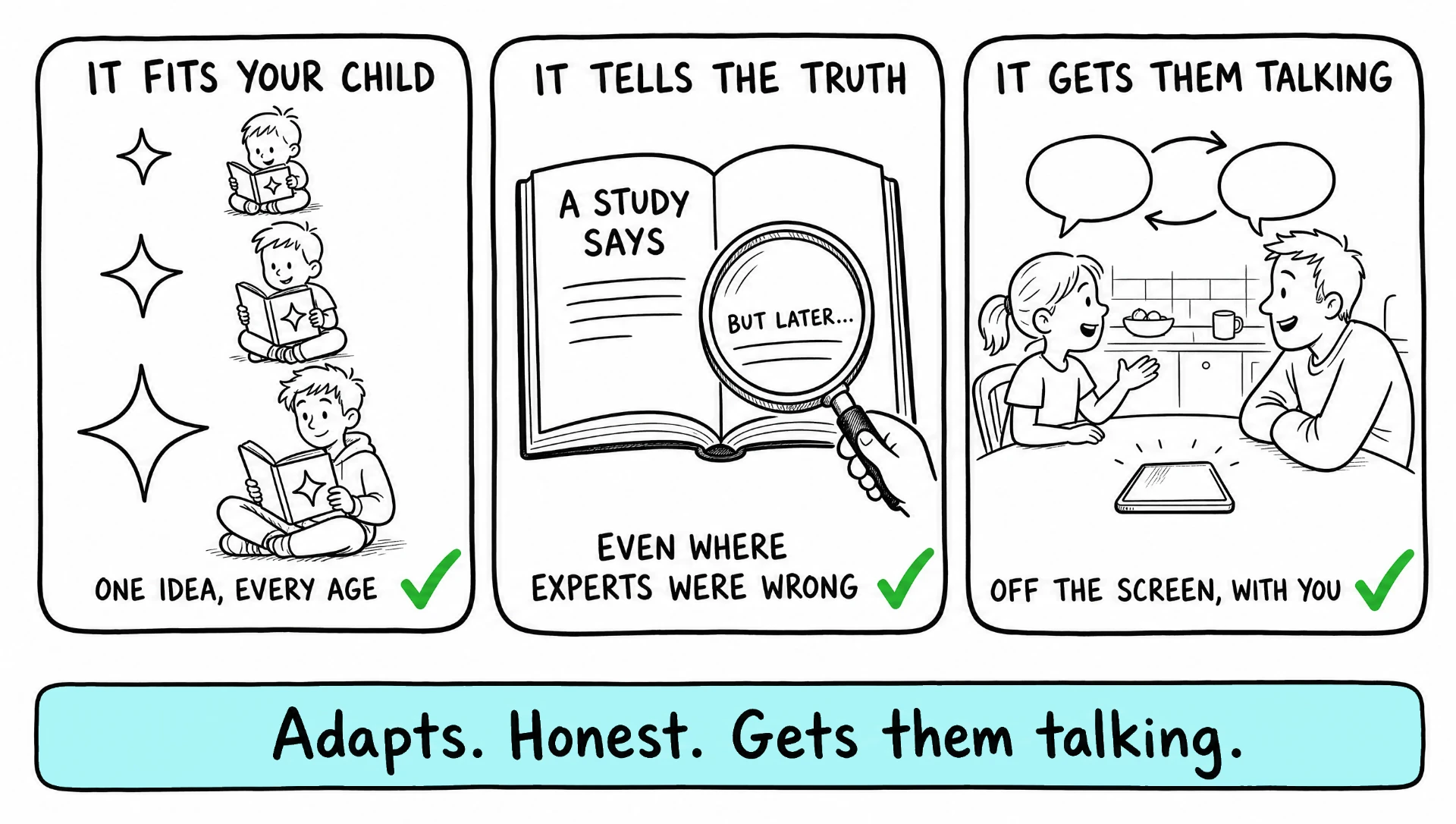
Most content picks an age and stays there. YoungThinkr doesn't. Every single lesson exists in four versions, from playground-simple for an eight-year-old to genuinely academic for a sixteen-year-old, and the platform serves the right one for your child. The same idea, first principles thinking, reaches your youngest as a story about building a den, and your eldest as a properly rigorous method with the real research behind it.
This means two things for a family. A younger and an older child can both use it, each meeting the idea at their level. And it grows with your child, so it isn't outgrown in a year.
2. It is honest, including where the experts were wrong
This is the part we are proudest of, and it is rare.
A lot of children's content quietly rounds the truth off until it is comfortable and no longer quite accurate. We refused to do that. YoungThinkr teaches the genuine work of more than ninety of the world's most important thinkers, including eleven Nobel laureates, correctly attributed. And where a famous idea was later shown to be shakier than the popular version suggests, we teach that too.
Children learn the famous marshmallow test, and the later research that complicated it. They learn about willpower, and the studies that failed to replicate. They learn that "a study showed" is the beginning of a question, not the end of one. We treat children as clever enough for the truth, footnotes and all, which is exactly the respect that builds real thinkers rather than confident parrots.
3. It gets them off the screen and talking to you
Every topic ends with a real-world mission, something your child does away from the screen, usually with you. Interview a grandparent about money. Map the systems in your own house. Run a small experiment on their own attention. And a short Family Conversations Guide gives you the questions to ask at the dinner table, no preparation needed.
The result is a product designed to create conversation, not replace it. Families tell us it makes them talk more, not less.
Built on real learning science
Underneath the design sits the actual evidence on how people learn: retrieval practice, spacing, and teaching children to notice how their own minds work. These are among the most replicated and highest-impact findings in education. We didn't invent a method; we built the platform around the one that works.
See for yourself
The best way to judge any of this is to watch your own child use it. We are opening the first four modules free to a first group of families, and all we ask back is your honest opinion. Come and see whether it is different in the way that matters. Request early access