
By 12 most children can do the maths of money and almost none have been told how money behaves: that a pound loses power while it sits still, that a price is not a value, and that compounding runs both ways. Here are the ten ideas worth putting to them before the first payslip, price tag or buy-now-pay-later button does it the expensive way.
By 12, most children can work out 15% of £80. Ask the same child why £80 today won't buy the same things when they're 30, and you'll usually get a shrug. Not because they're not clever. Because nobody has ever put it to them.
There's a difference between learning the maths of money and understanding how money behaves. The first is on the curriculum. The second mostly isn't, and it's the one they'll make real decisions with: the first phone contract, the first payslip, the first "buy now, pay later" button, the first time a friend says "everyone's got one."
We tend to teach these things after children have started making the decisions. This is a case for teaching them before. Ten ideas, none of them advanced, each one something a 12-year-old can start using this week.
Key takeaways
- School teaches the maths of money. It rarely teaches how money behaves, and behaviour is what a child's first real decisions will run on
- A pound coin says one pound forever, but what it can do shrinks every year. Inflation is the lesson almost nobody puts to a child
- Compounding is the best deal your child will ever be offered and the most expensive one they can fall into, because debt is the same maths running backwards
- The single most useful habit is naming the trick: decide what you'd pay before you see the price, and say "that's anchoring" when you feel the pull
1. Price is not the same as value
Price is what the label says. Value is what the thing is worth to you. They come apart constantly, and a child who can hold them apart is much harder to sell to.
The easiest way in: "What would you pay for this?" Ask it before the price is visible. Then reveal the price and compare. Sometimes the child's number is higher (they wanted it more than the shop expected). Sometimes it's lower (the shop is charging for the logo). Either way, they've just separated the two ideas without a lecture.
2. Every choice costs the thing you didn't choose
Economists call this opportunity cost. Children understand it instantly if you make it concrete.
You've got £2 at the fair. Bouncy castle or toffee apple. You pick the castle. What did it cost? £2, yes. And the toffee apple. Every choice quietly costs the next best thing you didn't pick, and it works for time as well as money: a Saturday on games costs the bike ride you skipped.
This one matters because it's the antidote to "but it's only £3." Only £3 compared to what? To the other thing the £3 could have done.
3. Prices come from a tug of war
Shops and businesses set an asking price, but the price people actually end up paying is shaped by how many want the thing, how much of it there is, what the competition charges and what it cost to make. Snow day, one hot chocolate stand at the bottom of the hill, a queue of thirty: the price goes up and people still pay. Same stand in April: not a chance.
Once a child sees this, "why is it so expensive?" turns into a better question: "who wants this, and how much of it is there?" That question explains concert tickets, trainers, house prices and why so many everyday prices, energy and food especially, jumped in 2022. Inflation is an average across a whole basket, so not every single item went up, but most of the ones a family notices did.
4. Money loses power while you're not looking
This is the one almost nobody teaches, and it's the one the article title is about.
A £1 coin says one pound forever. What it can do changes every year. Gran's pound bought a bag of sweets with change. Yours buys five sweets. Same coin. Same shop, even. The coin lost some of its power.
That's purchasing power, and inflation is what erodes it. A tiny rise each year is normal and expected. The trouble comes when prices sprint and pay walks. In the year to October 2022 UK inflation hit 11.1%. Someone with £10,000 in a savings account earning 1% ended that year with £10,100 on their statement and roughly £1,000 less buying power, depending on exactly how you measure it. The number went up. What it could do went down.
The exercise that lands it: ask the oldest person your child knows what pocket money they got and what it bought. Then work out what that costs now. Inflation is abstract on a chart and unforgettable when it's measured in someone's old sweets.
5. Where money actually comes from
Ask most adults where money comes from and they'll say "the government prints it." That's a small part of the answer. Most of the money in the country isn't notes or coins at all. It's numbers in accounts, and most of it was created by banks when they lent it.
Mr Patel asks the bank for £900 for a van. The bank doesn't hand him £900 from a safe. It creates a £900 deposit in his account. That £900 is new. It didn't exist a minute ago. As he pays the loan back, that deposit money is extinguished again; the interest he pays on top is the bank's income and works differently. Money in our world breathes in and out like that. Banks can't do it without limit: rules, the capital they have to hold, the funding they can get and whether anyone wants to borrow all constrain it.
Why does a 12-year-old need this? Because it reframes what a loan is, and what a bank is, before they meet either one as a customer. And because it answers the question every child eventually asks: "why can't they just make more money?" They can, within limits. Whether that pushes prices up depends on how much the economy can produce, whether people are spending, what the government is doing, and a lot else. More money doesn't automatically mean higher prices, but it often does, and that's the part worth understanding before you're old enough to vote on it.
6. Compounding is the best deal they'll ever be offered, and it's time-limited
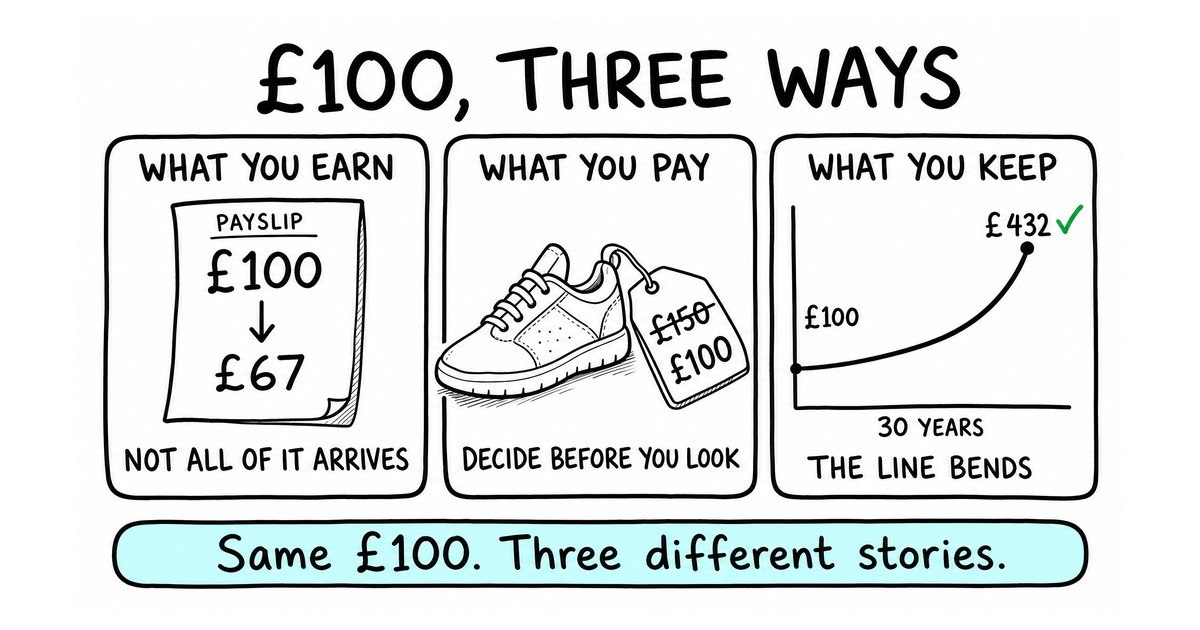
£100 saved earning 5% a year is £163 after ten years and £432 after thirty. At 7% it's £761. The growth isn't a straight line; each year's interest earns interest of its own, so the curve bends upwards.
The part that changes behaviour is the timing. £100 a month from age 18 at a steady 7% comes to roughly £525,000 by 68, before inflation, fees or tax. The same £100 a month started at 28 comes to roughly £262,000. Ten fewer years of saving, less than half the result. Starting earlier doesn't mean later saving is pointless. It means the earliest money has the longest time to compound, and that gives it an advantage nothing else can copy. And 5% or 7% are illustrations, not promises: a savings account, a pension and a share fund carry different risks, and none of them guarantees a number.
Don't tell them this. Let them guess what £100 becomes after 30 years at 7%, then work it out together. Almost everyone guesses far too low. The gap between the guess and the answer is the lesson.
7. Debt is the same maths running backwards
Compounding doesn't care whose side it's on. A £2,000 credit card balance at 22% APR, paying only the minimum each month, can take well over a decade to clear. MoneyHelper's worked example, with a 2.5% minimum payment, comes out at about 14 years. The exact time and the interest bill depend on the card's minimum-payment rule, any fees, and whether you keep spending on it. Minimum payments keep you out of trouble with the lender. They are usually a very expensive way to pay something off. That isn't a flaw in the product. It's the product.
A 12-year-old doesn't need to fear debt. They need to be able to see it, and to know that not all of it is the same: a credit card at 22%, a student loan, a mortgage and an interest-free "buy now, pay later" plan have very different costs and protections. Buy now, pay later is credit. Paid on time it can cost nothing; miss a payment and there can be fees. Since July 2026 most of it in the UK is regulated by the FCA, which tells you something about how much of a loan it always was. Once they know compounding runs both ways, they can read all of these for what they are.
8. A payslip is not what you earn
The salary in a job advert is the gross figure, not the number that arrives in the bank. Once someone earns enough in a year, income tax and National Insurance come off, and often a pension contribution too. How much depends on total pay, tax code, how often they're paid and what pension they've chosen, so a single £100 day on its own might have nothing taken from it at all.
As an illustration only: for an adult on a basic-rate salary, every £100 of pay above the tax-free allowance loses about £20 to income tax and £8 to National Insurance, and perhaps £5 to a pension if they're in one. Roughly £67 reaches the bank. The tax and National Insurance go to public spending and contributory benefits. The pension money is still theirs, just locked away for later.
Show them a real payslip if you're comfortable. Nothing lands like the actual number. The point isn't that tax is bad. It's that a salary is a sentence with some maths hidden in it, and they should be the one who does the maths.
9. Businesses make money by solving problems, and that's a thing a child can do
You give a 12-year-old £20 and ask how they'd turn it into £30. Most will reach for a business idea. Steer them somewhere more useful: what problem could you solve? Who has that problem? What would they pay? What would it cost you? What's the smallest way to test it? What would make someone say no?
That's the whole of business in six questions, and it's a better use of a wet Saturday than a lecture on entrepreneurship. The point isn't to raise a founder. It's to raise a child who sees a price and thinks about what's behind it, and who knows the difference between money coming in and money left over.
10. Their brain is bad at money, and that's fixable
The label says "was £100, now £60." Is £60 a good price? You don't know. £100 has already changed how £60 feels. That's anchoring: the first number you see pulls your judgement towards it, and it works even when you know it's happening.
Then there's the countdown timer that never actually ends, the "only 2 left," the free sample that makes you feel you owe something back. None of these are illegal. All of them are aimed at a brain that hasn't been told about them.
The defence isn't willpower. It's naming. A child who can say "that's anchoring" when they feel the pull is the one in charge of the decision. The habit to build: decide what you'd pay before you look at the price. Decide first, look second.
Try this with your child
You're given £100.
Option A: keep it in cash for ten years.
Option B: put it somewhere earning 5% a year.
What happens? Work it out. Then add 3% inflation to both.
Which number actually matters: the pounds, or what they buy?
That one exercise covers purchasing power, compounding and the reason saving in a tin is not the same as saving. It takes ten minutes and a calculator, and it's the single most useful money conversation most families never have.
Where this comes from
Everything above is drawn from Module 6 of the YoungThinkr curriculum, What Is Money?, which teaches purchasing power, inflation, how banks create money and compound interest, each written four times over for ages 8 to 16, plus the anchoring lesson in The Thinker's Toolkit. The printable version of the payslip, price and savings exercise is Your First £100, free on our socials this week with the code MONEY.
YoungThinkr launches with the first four modules in full. What Is Money? is coming next. The dinner-table version of it doesn't need to wait.