Most children revise by re-reading and highlighting, which feels productive and barely works. Here is what decades of research actually say, and the uncomfortable fixes that make revision finally stick.
Here is one of the best-kept secrets in education: most children revise in a way that barely works, and nobody ever taught them a better one.
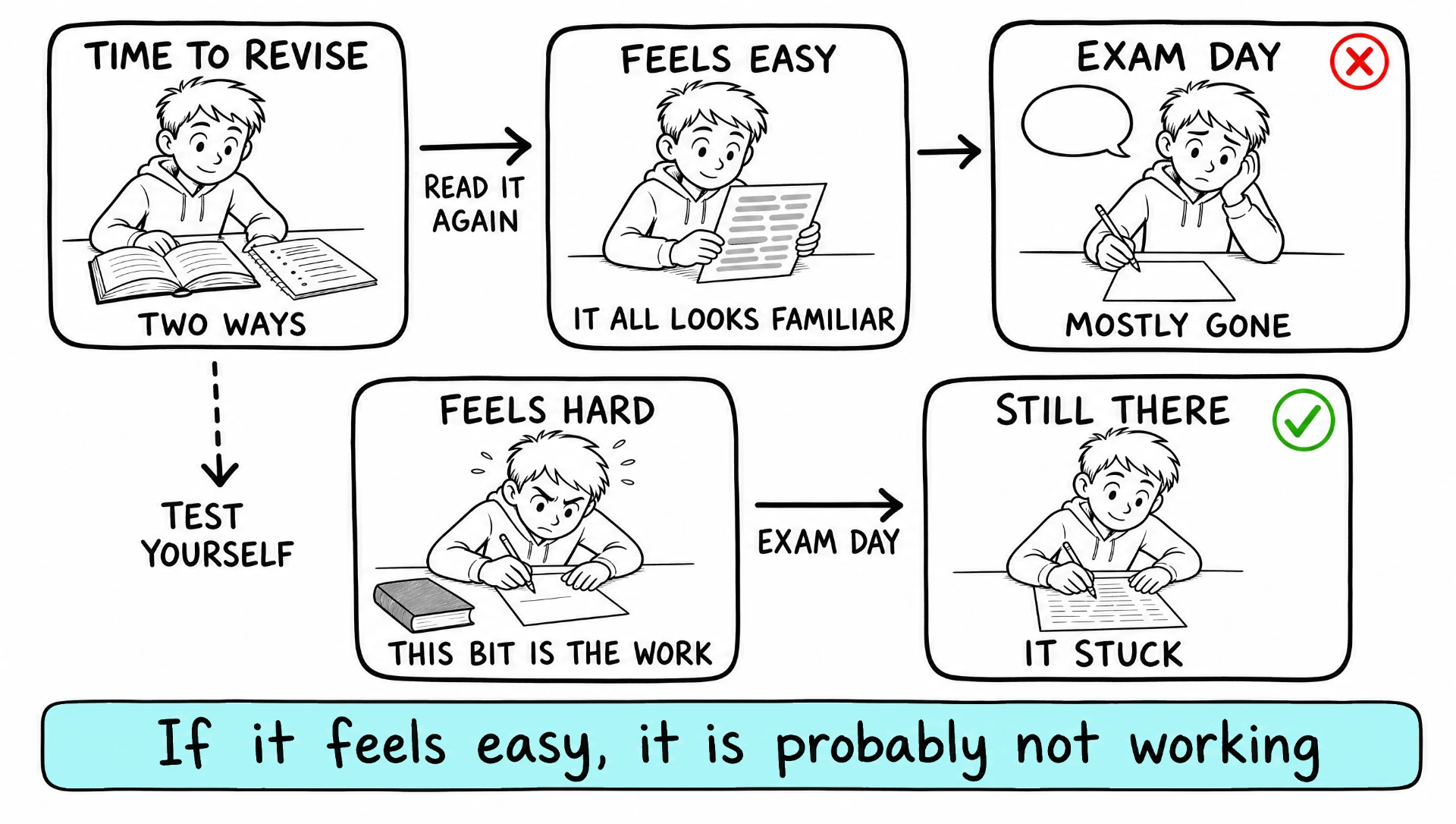
The usual method is to read the notes again, maybe highlight a bit, and read them again. It feels productive. You recognise the words, so your brain says "yes, I know this." That feeling is the trap. Recognising something on the page is not the same as being able to recall it when the page is gone, and the exam is all about the page being gone.
Key takeaways
- Recognising notes on the page is not the same as recalling them in the exam. Re-reading feels productive and quietly fools you
- Testing yourself (retrieval practice) beats re-reading by a wide margin, even though it feels harder at the time
- Spreading practice across more days and mixing topics both beat cramming and single-subject blocks
- Effective revision feels like effort. That struggle is the sign it is working, and it is a teachable skill, not a talent
What actually works, and why it feels worse
Decades of research point to a better way, and it is uncomfortable, which is precisely why it works.
Test yourself instead of re-reading. Close the book and write down everything you can remember. Then check. Getting things wrong and correcting them builds far stronger memory than reading smoothly over material you already half-recognise. This is called retrieval practice, and it beats re-reading by a wide margin in study after study.
Spread it out. The same total hours, split across more days, stick far better than one long session the night before. Cramming gets you through tomorrow's test and fails you next month.
Mix it up. Doing a bit of several topics feels messier than one big block on one subject, and it works better, because your brain has to keep retrieving and switching, which is where the learning happens.
The uncomfortable rule underneath all of it
The methods that feel easy and pleasant are usually the weak ones. The methods that feel like effort, closing the book and struggling to recall, are usually the strong ones. That struggle is not a sign it isn't working. It is the sign that it is.
A child who learns this early has an advantage that compounds across every subject, for years, because they stop wasting the hours they do put in.
This is a skill, and it can be taught
None of this is obvious, and none of it is intuitive, which is why so many hard-working children still underperform. It has to be taught directly. One entire part of YoungThinkr, our "How to Learn Anything" module, does exactly that, from age eight to sixteen, with the real science made simple.
We are opening the first modules free to a first group of families. If your child works hard and it isn't quite translating into results, this is the one to start with. Request early access