Your child is the first generation growing up with a machine that will do their homework and sound completely certain even when it is completely wrong. Here is the one skill that actually protects them, and why banning screens won't build it.
Your child is the first generation to grow up with a machine that will write their essay, answer their homework, and sound completely certain, even when it is completely wrong.
That last part is the bit most people miss.
Key takeaways
- AI predicts words rather than looking up facts, so it can be fluent, confident and completely made up
- Your child's feed is tuned to keep them watching, not to make them wiser, and it shapes their world more than they realise
- Banning protects a child today; understanding protects them for life, once they are older and unsupervised
- The best defence is old-fashioned thinking - questioning claims, spotting incentives, checking before trusting - and it is teachable now, from a young age
Why "confident" and "correct" are not the same
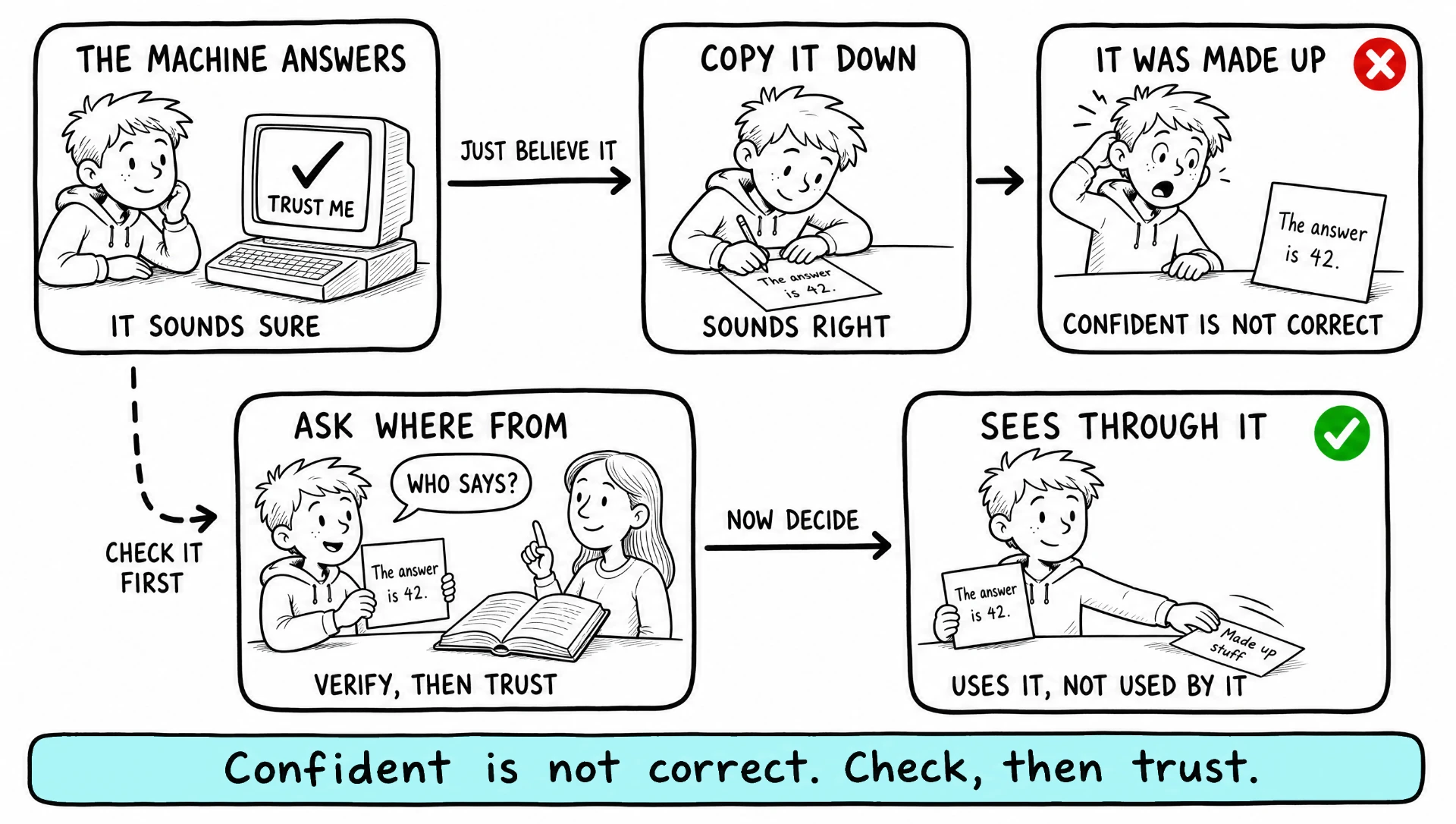
An AI chatbot does not look facts up in a database. It predicts what words should come next. That means it can produce something fluent, polished, confident and entirely made up, and a child who does not understand how it works will believe it, because it sounds exactly like something true.
Meanwhile, the feed on their phone is quietly deciding what they see, tuned not to make them wiser but to keep them watching. It shapes their view of the world far more than they realise, and far more than a parent can police.
You cannot ban your way out of this
Keeping a child off their phone protects them today. It does nothing for the day they are eighteen, unsupervised, and facing a slick AI answer or an engineered feed on their own. The only durable protection is understanding.
A child who knows how these systems actually work, why an AI sounds sure when it is guessing, why their feed shows them what it shows them, how to check a confident answer before trusting it, is far harder to mislead than one who was simply told to stay off their phone.
The best defence is the oldest thinking
Here is the reassuring part. The tools that protect a child in 2026 are not new. They are the oldest thinking skills there are. First principles reasoning. Spotting a manipulated statistic. Understanding an incentive, asking "who benefits if I believe this?" These are exactly what let a person see through a slick AI answer or a designed feed. The skills that have always separated the people who get fooled from the people who don't are the same skills that protect a child from a machine.
And they are teachable, now, from a young age.
What we do
YoungThinkr teaches children how AI and algorithms really work, honestly and without hype, and builds the underlying thinking that lets them use these tools without being used by them. It is one part of a wider curriculum that runs from age eight to sixteen and teaches, above all, how to think.
Your child is going to grow up alongside this technology whether you like it or not. The question is only whether they understand it. We are opening the first modules free to a first group of families, and we would love yours to be one of them. Request early access